Where style meets the sea
Underwire swimsuits for real support: bikinis and one-pieces that hold up
You have tried “supportive” swim tops that were really just thicker foam and a tighter band, and you still felt bounce on the walk from the towel to the water. Underwire swimsuits are not the only answer for larger busts, but when the wire is placed correctly and paired with the right band and strap geometry, they behave more like swim bras than like fashion layers pretending to be bras.
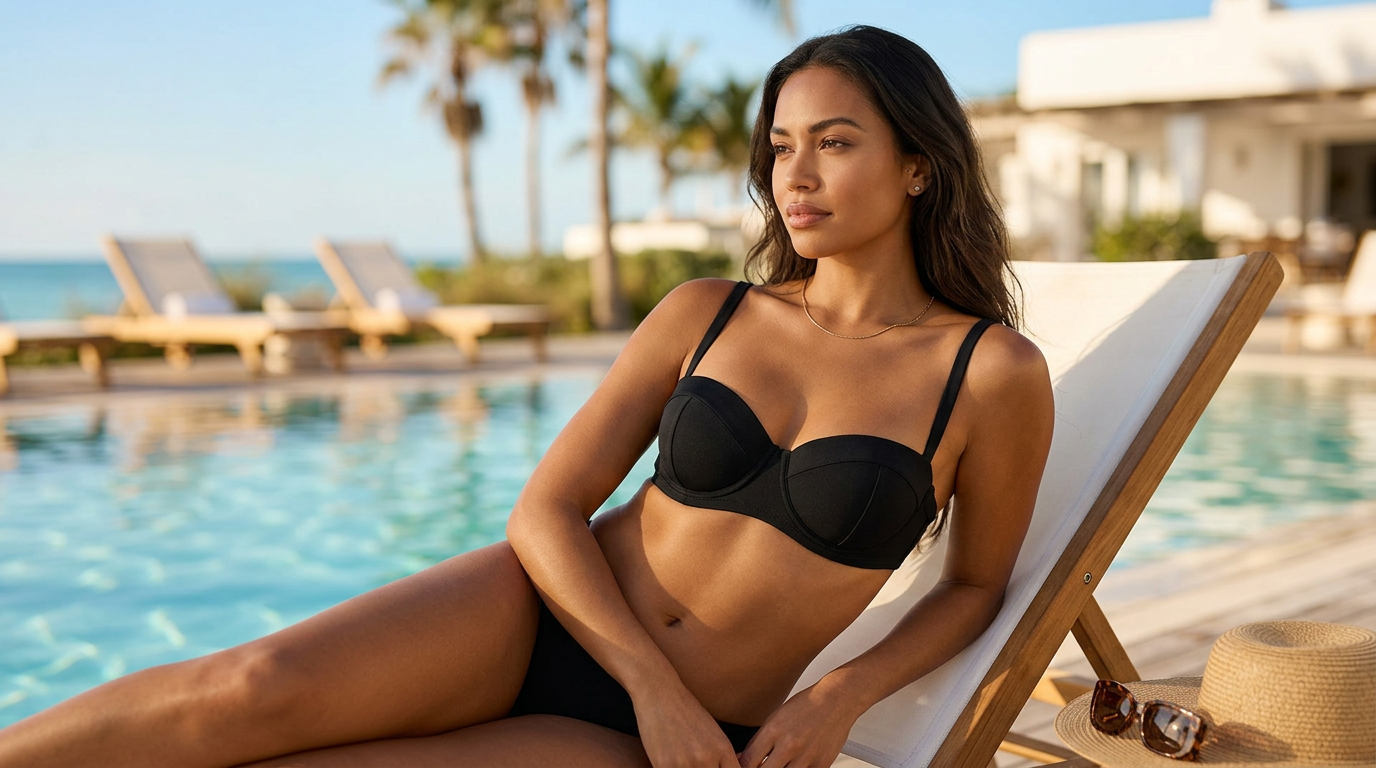
Disclaimer: The lifestyle image above is AI-generated and shows a look-alike for editorial purposes; it is not the exact product from any retailer’s listing.
For a real-world reference, see the catalog product photo on TA3 Bombshell Bikini Top (Black)—the same structured-cup silhouette we discuss when evaluating underwire swim support.
This guide explains what to verify on the product page, how underwire differs from shelf bras and longline compression, and how to avoid buying a cute top that fails the first time you dive.
What underwire is doing in swim
In bras, underwire shapes the cup and helps distribute weight. In swim, it does the same only if the suit’s internal architecture matches your shape: wire that floats away from the body, cups that are too shallow, or bands that ride up will still fail—just with more hardware.
You might be thinking, “I hate underwire in daily bras—why would I want it at the beach?” Fair. Some swimmers do better with wide straps, encapsulation, or longline styles without wire. Treat underwire as a precision tool: best when you want lift and separation in structured cups, not when you want soft lounge compression.
When underwire swimwear is worth it (and when it is not)
Worth it when you want defined cup shape, lift, and predictable strap load on a long pool day—especially if you already know your bra size behavior and can map it to cup-sized swim.
Skip it when your priority is soft lounge, minimal hardware, or rash-prone skin along the wire channel—some people do better with encapsulation or compression styles that do not rely on metal channels at all.
If you are mostly wading and posing, you can prioritize neckline and fabric. If you are swimming, prioritize anchoring and band stability first.
Fit checks before you trust the label
Cup depth vs. wire width: If reviews mention “poking” or “sitting on tissue,” that is often a shape mismatch, not a defective wire.
Band stability: Swim stretches when wet. Look for adjustable backs, multiple hook positions, or firm wing panels if the brand shows them.
Strap routing: X-backs and racerbacks can anchor weight differently than halters. Halters trade neck strain for lift—know your tolerance.
Coverage honesty: A deep plunge with underwire can still be supportive if the side wing is tall enough. A high neck with a flimsy band cannot be saved by wire alone.
One-piece vs. bikini underwire
Bikini tops let you size top and bottom independently—valuable when your bust and hip measurements do not track a single “dress size.” One-pieces can add torso compression and keep the band aligned, but gapping at the bust or pulling at the shoulders means the torso pattern is wrong for you, not that you need a smaller label size.
Chlorine, salt, and hardware
Chlorine and salt do not “eat” underwire overnight, but they accelerate wear on elastane and thread around the wire channel. Rinse after salt, rotate suits if you swim daily, and retire anything with broken casing—exposed wires are a safety issue, not a style issue.
Shopping mistakes that waste money
- Buying a cup-sized top without checking sister sizing behavior in that brand’s swim—some labels run shallow for the same letter.
- Trusting a push-up pad alone for “support” when what you need is band depth and strap geometry.
- Ignoring return windows on final-sale colors—fit-sensitive categories deserve a try-on policy.
Key brands and examples
- Sunset and Swim is worth keeping in your rotation when you want edited picks and fewer open tabs while you compare support claims across brands.
- SwimOutlet helps when you want cup-sized inventory and performance-adjacent filters in one search surface.
- ASOS can surface fashion-forward silhouettes—verify cup depth and return policy before you commit to a trend-led neckline.
- Bare Necessities and similar bra-first retailers sometimes carry swim with bra-grade sizing language—useful when you already know your everyday bra size behavior.
- Nordstrom can reduce friction when you need easy returns on multiple cup sizes or sister sizes to compare lift.
Use each PDP as a lab report: read fiber content, closure type, and model photography from the side—not just the front hero shot.
Care notes
Chlorine and sunscreen degrade elastane. Rinse cold after wear, avoid machine drying structured cups unless the label allows it, and store cups without folding wires sharply—especially on molded styles.
FAQ
Are underwire swim tops safe in salt water? Rinse promptly; salt and sand are abrasive to hardware and fibers alike.
What if I am between band sizes? Try the band first—support mostly lives there. A loose band makes the wires work harder and feel sharper.
Do I need underwire if I am a D cup? Not automatically. Some D cups do brilliantly in encapsulation tops. Underwire helps when you want defined cup shape and separation.
What is the honest signal to size up? If the wire sits on breast tissue at the side, cup depth is usually wrong—sizing up in the band alone will not fix it.
Can I machine wash underwire swim? Only if the label says so—most structured cups last longer with gentle hand wash and flat drying.
Underwire swim works when you shop like you are buying equipment: prioritize band stability, cup depth, and strap routing, then buy the colorway—not the other way around.